
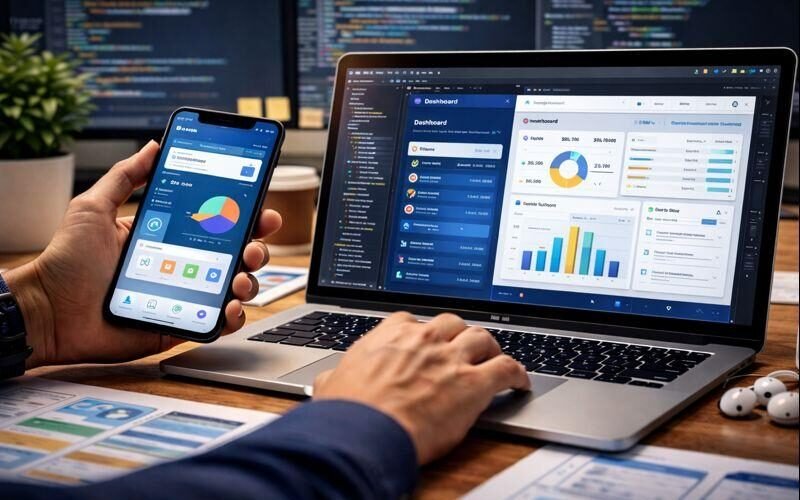
Businesses today are using technology to improve their services, connect with customers, and manage daily operations. As more people use smartphones for shopping, communication, payments, and other everyday activities, mobile applications have become an important part of business growth.
A mobile application allows businesses to connect directly with customers, provide convenient services, and create better customer experiences. However, not every business has the same goals or requirements. This is why custom mobile application development is becoming an effective solution for businesses that want to grow and stay competitive.
Unlike ready-made applications, custom mobile applications are designed according to a company’s specific needs, services, and business goals. They offer flexibility, better functionality, and opportunities for future improvements.
What Is Custom Mobile Application Development?
Custom mobile application development is the process of creating a mobile app specifically for a business, organization, or individual. The application is designed based on the company’s requirements, target audience, and services.
For example, a restaurant may need an application for online food ordering, while a transportation company may need an app for ride booking, driver tracking, and digital payments.
A custom mobile application can include different features, such as:
- User registration and profile management
- Online booking and appointment scheduling
- Secure payment integration
- Push notifications and real-time updates
- Customer support and communication
- Order tracking and management
- Reports and business analytics
These features help businesses provide services more efficiently while giving customers a convenient way to interact with them.
1. Better Customer Experience

Customer experience plays an important role in business success. Customers expect services to be simple, fast, and accessible. A well-designed mobile application makes it easier for customers to access business services directly from their smartphones.
Instead of visiting a physical location or making repeated phone calls, customers can use an application to explore services, make bookings, place orders, and receive updates.
For example, a service-based business can develop an application that allows customers to:
- View available services and prices
- Schedule appointments
- Track service requests
- Make online payments
- Contact customer support
Providing these options through one mobile application saves customers time and improves convenience.
When customers have a positive experience, they are more likely to return and recommend the business to others.
2. Strengthens Brand Identity
A mobile application is another way for businesses to build their brand identity. It provides a digital platform where customers can interact with the company’s products, services, and information.
With custom mobile application development, businesses can choose their own design, colors, logo placement, and features. This helps create a consistent brand experience.
A professional mobile application can also make a business look more organized and reliable. When customers regularly use an application that represents a company’s brand, it creates more opportunities for recognition and engagement.
Businesses can also use branded notifications, promotional offers, and personalized messages to maintain communication with their customers.
3. Improves Business Efficiency and Productivity
Managing business operations manually can take time and create unnecessary challenges. Employees may need to handle bookings, customer requests, payments, and records separately.
A custom mobile application can bring many of these activities into one digital platform.
For example, a business application can help automate:
- Customer registration
- Appointment management
- Booking confirmations
- Payment processing
- Employee task management
- Service request tracking
By reducing repetitive manual work, businesses can save time and focus on more important activities.
Applications can also help employees access necessary information more quickly, improve coordination, and manage daily responsibilities efficiently.
As a result, businesses can improve productivity while reducing operational difficulties.
4. Direct Communication Through Push Notifications
Communication is essential for maintaining strong relationships with customers. Mobile applications provide a direct communication channel through push notifications.
Businesses can use notifications to share important information, including:
- New product and service announcements
- Special offers and discounts
- Booking confirmations
- Order status updates
- Appointment reminders
- Important business announcements
For example, a customer who books a service through a mobile application can receive a notification when the booking is confirmed or when the service provider is on the way.
This keeps customers informed and reduces the need for repeated communication.
However, businesses should send relevant and useful notifications rather than overwhelming customers with unnecessary messages.
5. Customized Features Based on Business Requirements
Every business operates differently. A feature that works well for one company may not be suitable for another.
This is one of the biggest advantages of custom mobile applications. Businesses can develop features based on their specific requirements instead of depending on the limitations of ready-made software.
For example:
- Healthcare businesses: Appointment scheduling, patient communication, and service information.
- Transportation businesses: Ride booking, driver tracking, and fare management.
- E-commerce businesses: Product browsing, shopping carts, online payments, and order tracking.
- Service-based businesses: Service listings, provider profiles, bookings, and customer reviews.
- Educational institutions: Online learning, student portals, and course management.
These customized features help businesses deliver services that match their customers’ expectations.
6. Better Data Management and Business Insights

Understanding customer behavior and business performance helps companies make better decisions.
Custom mobile applications can include analytics and reporting features that help businesses understand how customers interact with their services.
Depending on the application’s design, businesses can monitor:
- Number of registered users
- Customer activity
- Popular products and services
- Booking and transaction records
- Customer feedback
- Business performance trends
This information can help business owners identify opportunities, understand customer preferences, and improve their services.
For example, if a company notices that customers frequently use one particular service, it can focus more on improving and promoting that service.
With the right data management system, businesses can make more informed decisions and plan for future growth.
7. Improved Security and Control
Security is an important consideration when developing a business mobile application. Applications may handle customer information, personal details, booking records, and payment transactions.
Custom mobile application development allows businesses to plan security features according to their operational requirements.
Some important security measures include:
- Secure user authentication
- Data encryption
- Role-based access control
- Secure payment integration
- Regular security updates
- Data backup and recovery
These measures help protect business information and improve customer confidence.
However, security is not a one-time activity. Businesses should regularly update their applications and review security practices to protect against potential risks.
8. Supports Business Growth and Scalability
As a business grows, its operational requirements also change. A small company may initially need only basic features, but later it may require advanced services, additional users, payment options, or integration with other systems.
Custom mobile applications can be designed with future expansion in mind.
Businesses can gradually add new features, improve existing functions, and integrate additional technologies as their requirements change.
For example, a business may begin with a simple booking application and later introduce:
- Online payment systems
- Customer loyalty programs
- Advanced reporting tools
- Multiple service categories
- AI-powered customer support
- Third-party service integrations
This flexibility helps businesses adapt to changing customer expectations and market conditions.
9. Creates a Competitive Advantage
Competition exists in almost every industry. Businesses need effective ways to attract customers and provide better services than their competitors.
A well-developed mobile application can help a company stand out by offering convenient services, personalized experiences, and faster communication.
For example, a company that allows customers to discover services, compare prices, book appointments, and make payments through one application may provide a more convenient experience than a business that manages everything manually.
A mobile application alone does not guarantee business success. However, when it is developed with the right strategy and customer needs in mind, it can become a valuable business tool.
10. Provides Long-Term Business Value
Developing a custom mobile application requires an initial investment. However, it can provide long-term value when it solves real business problems and supports important business activities.
Instead of depending on multiple disconnected systems, businesses can use one application to manage several processes.
Potential long-term benefits include:
- Reduced manual administrative work
- Improved customer retention
- More organized business operations
- Better access to business information
- Opportunities to introduce new services
- Improved communication with customers
The overall value of a mobile application depends on its development quality, maintenance, security, and ability to meet business requirements.
For this reason, businesses should focus on building applications that solve practical problems rather than simply adding unnecessary features.
How to Choose the Right Mobile App Development Company
Choosing the right development partner is an important step in creating a successful mobile application.
A professional development company can help businesses understand their requirements, select suitable technologies, design user-friendly interfaces, and develop reliable applications.
Before choosing a mobile app development company, consider the following factors:
1. Understand Your Business Requirements
Clearly identify what you want your application to achieve. Consider your target audience, business objectives, and the problems the application should solve.
2. Review Previous Projects
Check the company’s portfolio and previous development projects. This helps you understand its experience and technical capabilities.
3. Focus on User-Friendly Design
An application should be easy to navigate and provide a smooth experience across different devices.
4. Consider Security and Performance
Make sure the development team follows appropriate security practices and focuses on application performance.
5. Ask About Maintenance and Support
Mobile applications require regular updates, bug fixes, and improvements. Choose a development partner that can provide ongoing technical support.
6. Plan for Future Growth
Select a development approach that allows your application to grow as your business requirements change.
Working with the right technology partner can make the development process easier and help you build an application that supports your business goals.
Conclusion
Custom mobile applications have become an important technology solution for businesses that want to improve customer experience, simplify operations, and support long-term growth.
From better communication and customized features to improved productivity and business insights, a well-designed mobile application offers several opportunities for businesses across different industries.
However, successful application development starts with understanding business requirements and customer expectations. Companies should focus on useful features, simple design, reliable performance, and long-term maintenance.
At Tokma Technologies, we believe that the right technology can help businesses work smarter and serve their customers better. Our technology-focused approach aims to create practical digital solutions that support business needs and future growth.
Frequently Asked Questions (FAQs)
1. What is a custom mobile application?
A custom mobile application is an app developed specifically for a business or organization. It includes features and functions designed according to the company’s requirements and customer needs.
2. Why are custom mobile applications important for businesses?
Custom mobile applications help businesses improve customer experience, automate daily operations, communicate directly with customers, and manage services more efficiently.
3. How much does it cost to develop a custom mobile application?
The cost depends on the application’s features, complexity, design, platform, integrations, and development requirements. A simple application generally costs less than a complex application with advanced functionality.
4. How long does it take to develop a mobile application?
Development time depends on the project’s requirements. A basic application may take a few weeks or months, while a more complex application may require several months of planning, development, and testing.
5. Can a small business benefit from a custom mobile application?
Yes. Small businesses can use mobile applications to manage bookings, communicate with customers, promote services, accept payments, and improve daily operations.



Post a Comment